Most business owners pick a marketing budget the same way: find a percentage that sounds reasonable, multiply it by revenue, and hope it holds up. That number rarely comes from their own numbers. It comes from a blog post about somebody else's business.
Key takeaways
Set your budget from your own numbers (order value, purchase frequency, lifespan), not an industry percentage.
Aim for an LTV to CAC ratio of at least 3 to 1.
Reviews and referrals lower what each new customer costs over time.
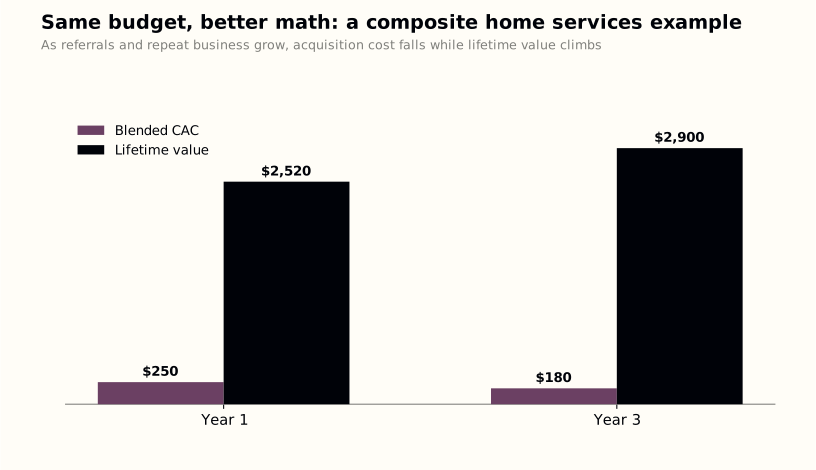
In the composite example, blended CAC falls from about $250 to about $180 while LTV rises past $2,900.
Stop Starting With a Percentage
Ask five home service owners what they spend on marketing and you will hear five different numbers. Some run comfortably at 2 to 3 percent and would rather grow slower than spend more. Others push past 15 percent and treat it as the price of taking new territory. Both can be right, because the percentage was never the actual decision. It is what is left over after a business already worked out what it can afford, given its margins, its overhead, and how fast it actually wants to grow.
That is the order that matters: start with margin and overhead, not with a percentage someone else published. A business running thin margins and heavy overhead cannot safely spend the same share of revenue as one with fat margins and low fixed costs, even if they are the exact same size.
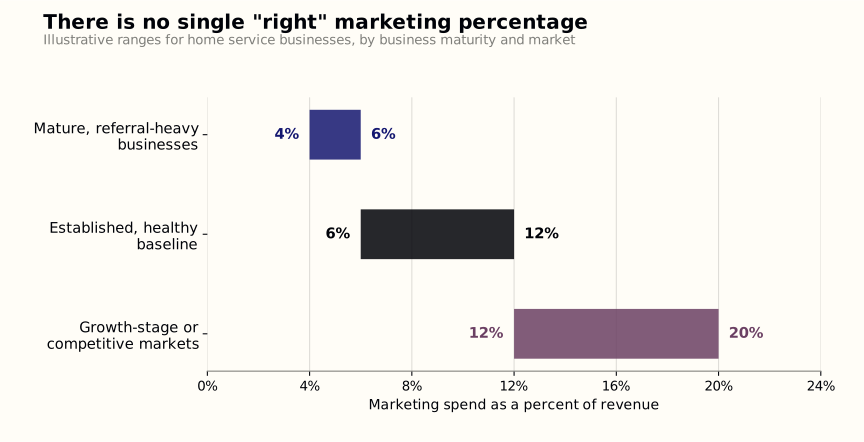
Published benchmarks are still useful once you flip the order. The U.S. Small Business Administration puts marketing spend at 7 to 8 percent of gross revenue for businesses under $5 million. Gartner's most recent CMO Spend Survey has the average closer to 7.8 percent of revenue, while The CMO Survey puts it at 9 percent, with B2C product companies running as high as 12 percent and B2B closer to 7. For home service businesses specifically, the range tends to run in three rough bands: mature, referral-heavy operators sustaining growth at 4 to 6 percent, an established healthy baseline of 6 to 12 percent, and growth-stage or highly competitive markets pushing 12 to 20 percent or more.
Use that range to sanity check your own number after you have worked it out, not to hand you one before you have.
What a Customer Is Actually Worth
Before you can decide what to spend acquiring a customer, you need two numbers: average order value and customer lifetime value.
Average order value, AOV, is simple: total revenue divided by number of orders. Lifetime value, LTV, is AOV multiplied by how often a customer buys and how long they stick around. A margin-adjusted version multiplies that result by your profit margin, which is the more honest number to actually plan spend against.
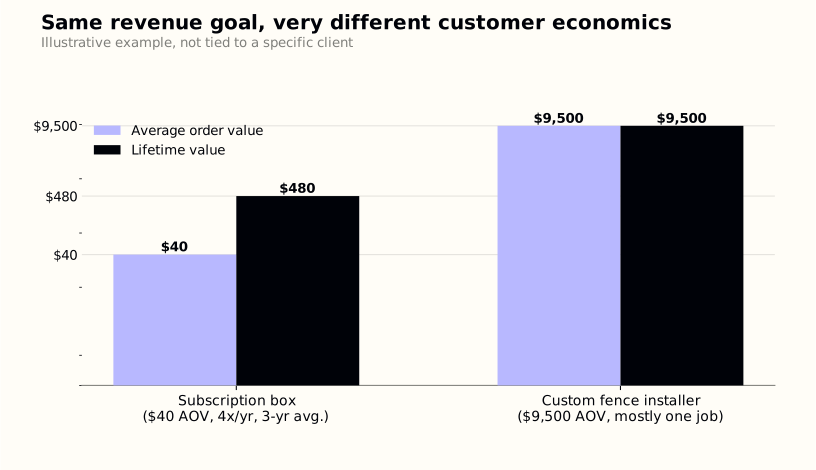
This is where two businesses with the same revenue can have completely different budgets that make sense. A subscription box with a $40 AOV, four orders a year, and a three-year average lifespan has an LTV around $480. A custom fence installer with a $9,500 AOV, mostly single-job relationships with occasional repeat gate or repair work, has an LTV close to that same $9,500. The fence installer can spend far more to win one customer and still come out ahead. The subscription box can't, and has to make its economics work on volume and retention instead.
Same revenue, very different budgets
Business
Order value
Lifetime value
Subscription box
$40, four orders a year, three-year lifespan
About $480
Custom fence installer
$9,500, mostly single jobs
Close to $9,500
The fence installer can spend far more to win one customer and still come out ahead.
What You Can Afford to Pay to Acquire One Customer
Once you know what a customer is worth, customer acquisition cost, CAC, is what you actually paid to get them: total sales and marketing spend divided by new customers in that period.
The widely used benchmark is an LTV to CAC ratio of at least 3 to 1, you want a customer worth at least three times what it cost to acquire them. Below 1 to 1, you're losing money on every customer. Between 1 to 1 and 3 to 1, you're in a risky zone that only works if something else is subsidizing growth. Above roughly 5 to 1, you're probably being too conservative and leaving growth on the table.
The 3 to 1 rule came out of mature, steady-state SaaS companies with stable churn and payback periods under a year. It's a reasonable starting target for most businesses, but the ratio that actually makes sense for you depends on your margins, how fast you need to grow, and how much cash you have to front the acquisition cost before it pays back.
Reading your LTV to CAC ratio
Ratio
What it means
Below 1 to 1
Losing money on every customer
1 to 1 up to 3 to 1
Risky; only works if something else subsidizes growth
3 to 1
The widely used starting target
Above about 5 to 1
Probably too conservative; growth left on the table
Why the Number Isn't Fixed: Reviews and Referrals Compound
Here's the part most marketing spend conversations skip: the ratio above isn't static. It moves, and it moves in your favor the longer you're in business, if you're actually earning reviews and referrals along the way.
Referred customers convert at roughly 4 times the rate of non-referred customers. Research published in the Journal of Marketing found their lifetime value runs about 16 percent higher, with 18 percent lower churn, and separate research from Wharton found referred customers cost about $23 less to acquire than non-referred ones. Some referral programs report acquisition costs falling as much as 60 percent compared to paid channels. Brand advocates and referred customers also tend to spend more per order, in some data by as much as 150 percent more than average.
Reviews do a version of the same thing before a lead even reaches you. The vast majority of consumers now read reviews before buying, and most say those reviews directly change their purchase decision. Products with even a handful of reviews convert meaningfully better than products with none, and businesses with strong reviews report customers spending more with them on average.
Put those two together and the math shifts twice: CAC drops as more of your new business comes through earned channels instead of paid ones, and LTV rises as retention and order value climb with it. A 3 to 1 ratio that felt aggressive in year one can look conservative by year three, not because you changed your spend, but because the customers you're spending on are worth more and cost less to reach.
~4xconversion rate of referred customers
16%higher lifetime value
$23less to acquire
A Composite Example: How the Math Moves Over Time
Take a hypothetical home services business. Average job value of $450, about 1.4 jobs a year per customer, average customer relationship of 4 years. That puts LTV around $2,520.
In year one, most leads come from paid channels, and blended CAC lands around $250 per new customer, still comfortably inside a healthy ratio. By year three, after two years of consistent reviews and word-of-mouth referrals, referral and repeat leads make up close to a third of new business. Those leads convert faster and cost less to close, pulling blended CAC down toward $180, while retention gains push LTV up past $2,900.
The business didn't cut its marketing budget to get there. It spent the same, or more, and got more efficient because the earned side of acquisition caught up with the paid side. That's the real argument for investing in service quality and review generation alongside ad spend: it doesn't just feel good, it directly lowers what you can safely pay to acquire the next customer.
Blended CAC in the composite example
Year one
~$250
Year three
~$180
Same or more marketing spend; the earned side of acquisition caught up.
Run Your Own Numbers
Everything above works the same way for your business, just with your numbers in place of the illustrative ones. Plug in your average order value, how often a customer buys, how long they stick around, and your margin, and this does the reverse-engineering for you: your lifetime value, the most you can afford to pay to acquire a customer, and, if you add your revenue and growth target, what that implies as a percent of revenue.
Marketing budget & CAC calculator
Reverse-engineer what you can afford to spend to win a customer, and see it as a percent of revenue.
Key terms: AOV = average order value. LTV = lifetime value (what a customer is worth over the whole relationship). Margin = your profit margin after costs. CAC = customer acquisition cost. LTV:CAC ratio = how many dollars of value you get back per dollar spent acquiring a customer.
Once you know what you can afford per customer, the next question is whether ads can hit that number in your market. Our guide on how to forecast your marketing budget before you spend a dollar covers cost per lead and closing rate, with a second calculator for that side of the math.
Already running Google Ads? We'll run this math against your real account for free. Our recorded Google Ads audit compares what you're paying per lead to what a lead is actually worth to you.
The Bottom Line
A percentage of revenue is a place to start a conversation, not a place to end one. The number that actually matters is what your own customers are worth to you, what it costs you to get one, and how that ratio is moving as your reviews and referrals build up. Get those three numbers right and the spend question mostly answers itself.
Frequently Asked Questions
What percentage of revenue should a business spend on marketing?
Most benchmarks put it between 7 and 12 percent of gross revenue depending on business type, with B2C businesses trending higher than B2B and smaller businesses trending higher than larger ones. Treat it as a sanity check against industry norms, not as your actual budget, since it doesn't account for what your specific customers are worth.
How do I calculate customer lifetime value?
Multiply average order value by how many times a customer buys per year and by how many years they typically stay a customer. For a more accurate number, multiply the result by your profit margin so you're planning against what a customer is actually worth to keep, not just what they spend.
What's a good customer acquisition cost?
It depends entirely on lifetime value. The common target is a lifetime value to acquisition cost ratio of at least 3 to 1. A CAC that looks high in isolation can be perfectly healthy if lifetime value is high enough to support it.
Do reviews and referrals actually change how much I should spend on ads?
Yes. Referred customers convert faster, cost less to acquire, and tend to stick around longer and spend more per order. As referrals and reviews become a bigger share of new business, blended acquisition cost drops and lifetime value rises, which means the amount you can profitably spend to win the next customer goes up over time.
Should every business use the same LTV to CAC ratio?
No. The 3 to 1 benchmark comes from mature SaaS companies with predictable churn and fast payback periods. Businesses with longer sales cycles, seasonal demand, or upfront cash constraints often need a different target. The ratio is a starting point for the conversation, not a rule to force your business into.