There’s a shift happening in paid media that most advertisers haven’t fully internalized yet: the algorithm no longer needs you to tell it who to target. It figures that out from your creative.
When you launch a founder story ad, you’re not just telling a narrative — you’re signaling to the algorithm that your product resonates with people who care about brand mission and authenticity. When you run an absurdist meme, you’re telling it that your audience speaks that language. The creative is the targeting. Which means the creative is the most important lever in your entire paid media strategy, and testing it rigorously is the highest-ROI thing most advertisers can do.
The problem is that most ad testing is undisciplined. Teams change the headline and the image in the same test, then can’t isolate what moved the number. Or they run tests too small to reach statistical significance and make decisions on noise. This playbook gives you 10 structured experiments with clear hypotheses and the measurement framework to actually learn from them.
Key takeaways
- The creative is now the targeting: the algorithm learns who to reach from your ad.
- Judge creative on hook rate and hold rate first; CPC and CPL follow when those are healthy.
- Change one variable at a time and wait for at least 50 conversions per variant.
- After 10–15 logged tests, you have a creative playbook no competitor can buy.
The Right Metrics First
Before the experiments, the measurement. Stop leading with CPC or CPL as your primary creative quality signal. These are outcome metrics — they tell you what happened after people engaged with your ad, not whether the creative was the cause. Two leading metrics tell you much more.
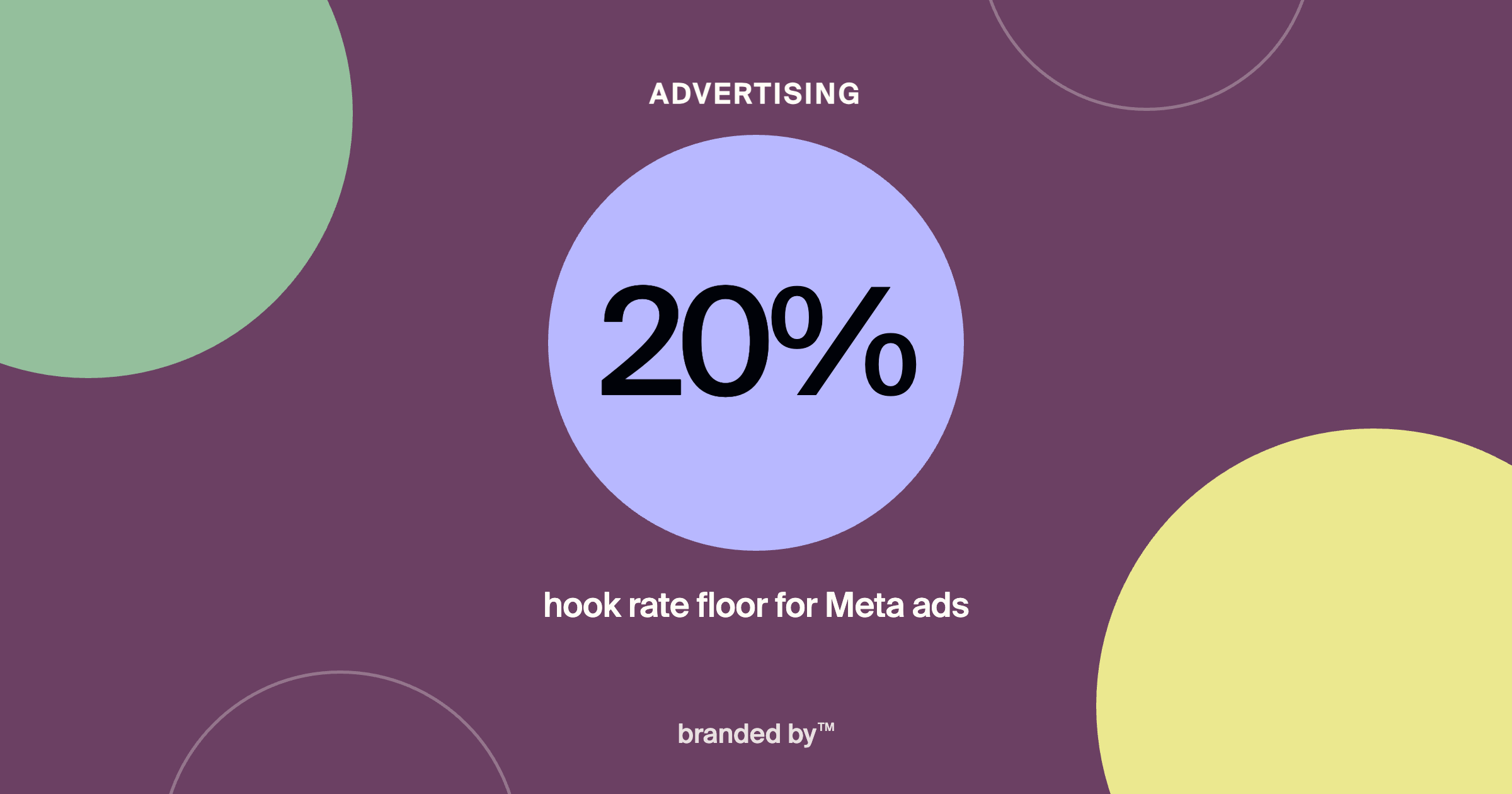
Hook Rate is the percentage of people who watch the first 3 seconds of your video (or stop scrolling on your image). This tells you whether your opening grabbed attention. If your hook rate is below 20% on Meta or below 15% on TikTok, the first frame of your ad is failing. Fix the opening before changing anything else.
Hold Rate is the percentage of people who watch past the first 3 seconds all the way through. This tells you whether your story held attention after the hook. A high hook rate with a low hold rate means your opening was misleading — people clicked expecting one thing and got another.
When these two metrics are healthy, CPC and CPL follow. When they’re not, no amount of targeting or bidding optimization will save you.
3 secwindow that defines the hook
20%hook rate floor on Meta
15%hook rate floor on TikTok
Experiment 1: The Hook Isolation Test
Hypothesis: Different opening frames will produce meaningfully different hook rates even when the rest of the creative is identical.
How to run it: Create five versions of the same ad with different first-3-second hooks, keeping everything after identical. Test: a direct problem statement, a surprising statistic, a before/after visual, a founder speaking directly to camera, and a pattern interrupt (something visually unexpected).
What you’re learning: Which opening psychology resonates with your audience. This is the highest-leverage test you can run because the hook determines whether anyone sees the rest of your creative at all.
Experiment 2: The Persona Call-Out
Hypothesis: Explicitly naming your target audience in the first line will improve both hook rate and conversion rate by filtering for qualified viewers.
How to run it: Test a generic opening against one that directly addresses your customer. Same rest of ad.
What you’re learning: The trade-off between reach and relevance. You’ll likely see lower impressions but higher conversion rates on the persona-specific version.
Experiment 3: Lo-Fi vs. Polished Production
Hypothesis: User-generated or low-production-value creative will outperform studio-produced creative in certain contexts because it reads as more authentic.
How to run it: Produce the same core message in two versions — one with professional lighting and editing, one filmed on a phone with natural lighting and minimal editing. Run them to identical audiences.
What you’re learning: Your audience’s trust triggers. Some products and audiences respond better to polish; many respond better to authenticity. The answer varies by category and demographic.
Experiment 4: The Social Proof Variation
Hypothesis: The type of social proof matters as much as the presence of social proof.
How to run it: Test three proof formats: a customer testimonial video, a stat, and a press mention or award. Same product, same offer.
What you’re learning: Which trust signal your audience responds to. B2B audiences often respond better to stats; consumer audiences often respond better to real customer stories.
Experiment 5: Problem-Led vs. Solution-Led Opening
Hypothesis: Leading with the problem your product solves will outperform leading with the product itself for audiences who haven’t yet identified their need.
What you’re learning: Where your audience is in their awareness journey. Cold audiences need problem validation before product presentation. Warm audiences just need the offer.
Experiment 6: Offer Framing
Hypothesis: How you frame the same offer changes conversion rate more than the offer itself.
What you’re learning: Whether your audience is motivated more by loss aversion, positive framing, or urgency. This varies significantly by category.
Experiment 7: Length Optimization for Video
Hypothesis: There is an optimal video length for your specific audience and platform, and it’s probably shorter than you think.
How to run it: Take your best-performing video ad and create 15-second, 30-second, and 60-second cuts. Run to identical audiences on the same platform.
What you’re learning: The attention budget your audience is willing to give you. Most teams discover their winning length is shorter than their default.
Experiment 8: CTA Copy Isolation
Hypothesis: The text on your CTA button or in your closing line moves conversion rate independently of the rest of your creative.
What you’re learning: Which action your audience is willing to take at this stage of awareness. Generic CTAs often underperform specific ones, but specific CTAs require matching commitment.
Experiment 9: The Negative Angle
Hypothesis: Leading with what not to do, or what’s wrong with the current approach, will out-hook positive framing in competitive categories.
What you’re learning: Whether your audience is more engaged by validation (positive) or by the fear of doing it wrong (negative). Categories with high stakes tend to respond more to the negative.
Experiment 10: The Founder/Human vs. Brand Voice
Hypothesis: A real person speaking authentically about a product will outperform polished brand-voice creative in most consumer and B2B categories.
What you’re learning: How much your audience values the human element. This test almost always produces a clear winner, and it’s more often the human version than most advertisers expect.
The 10 experiments, grouped by what they teach
| Group | Experiments | What you learn |
|---|
| The opening | Hook isolation, persona call-out, problem vs. solution, negative angle | Which opening psychology and awareness stage lands |
| Production and voice | Lo-fi vs. polished, founder vs. brand voice | Your audience's trust triggers |
| Proof and offer | Social proof variation, offer framing | Which trust signal and motivation converts |
| Length and close | Video length, CTA copy | Their attention budget and the action they'll take |
Running These Without Losing Your Mind
The structural requirement for any of these tests to produce usable data: change one variable at a time, run long enough to reach statistical significance (at minimum 50 conversions per variant), and document your hypothesis before you run the test so you’re evaluating evidence rather than rationalizing outcomes.
Keep a simple testing log: hypothesis, variable changed, result, implication. After 10–15 tests, you’ll have a genuine creative playbook specific to your audience that no competitor can buy off the shelf.
Need test ideas beyond this list? The free competitor ad snapshot pulls the Google, LSA and Facebook ads your competitors are running right now.
Frequently Asked Questions
What is ad creative testing?
Ad creative testing is running controlled variations of your ads — changing one element at a time, like the hook, offer, or format — to learn what drives better results with your audience.
What metrics matter most in creative testing?
Hook rate (people who watch past three seconds), hold rate, click-through rate, and cost per result. Early-funnel metrics tell you why a creative won; cost per result tells you whether it matters.
How long should you run a creative test?
Until each variation has enough data to compare — typically at least 1,000 impressions per variant for hook tests, and more for conversion-based tests. Avoid calling winners after a day or two.
Related Articles