September 29, 2026
How a Local Business Becomes the Name Everyone Knows
Ask anyone in your town who to call for a new roof and most will say the same name. Here's how a local business becomes that name, and why there's no shortcut.
Agencies use Claude, Anthropic's AI assistant, mostly for seven jobs: first-draft content production, research and competitive analysis, client reporting, proposals and pitches, social media content, internal knowledge management, and creative brainstorming. In each case the pattern is the same — Claude handles the blank page and the synthesis, and people handle judgment, editing, and client relationships. Below is how each workflow works in practice, plus how agencies are helping clients get recommended by Claude.
Running an agency has never been easy. You're managing clients, juggling deadlines, maintaining quality, and trying to grow — all at the same time. The pressure to do more with less is relentless. Over the last two years, a growing number of agencies have started turning to AI to close that gap, and one tool that keeps coming up in those conversations is Claude, Anthropic's AI assistant.
This isn't a post about AI replacing your team. It's about how real agencies — creative shops, digital marketing firms, PR agencies, and branding studios — are weaving Claude into their day-to-day operations to move faster, produce better work, and ultimately serve clients more effectively.
Let's look at the use cases that are actually working in the wild.
Key takeaways
Content is the engine of most agency offerings. Blog posts, social captions, email sequences, ad copy, landing pages — the demand is constant and the deadlines are tight. For many agencies, content has become a bottleneck: too much to write, not enough writers, not enough time.
Agencies using Claude have found it especially effective as a first-draft engine. A strategist or account manager provides a brief — the target audience, key message, tone of voice, word count — and Claude produces a structured draft that the creative team then shapes and refines. What used to take a writer two to three hours to draft from scratch now takes thirty to forty-five minutes of human-guided work.
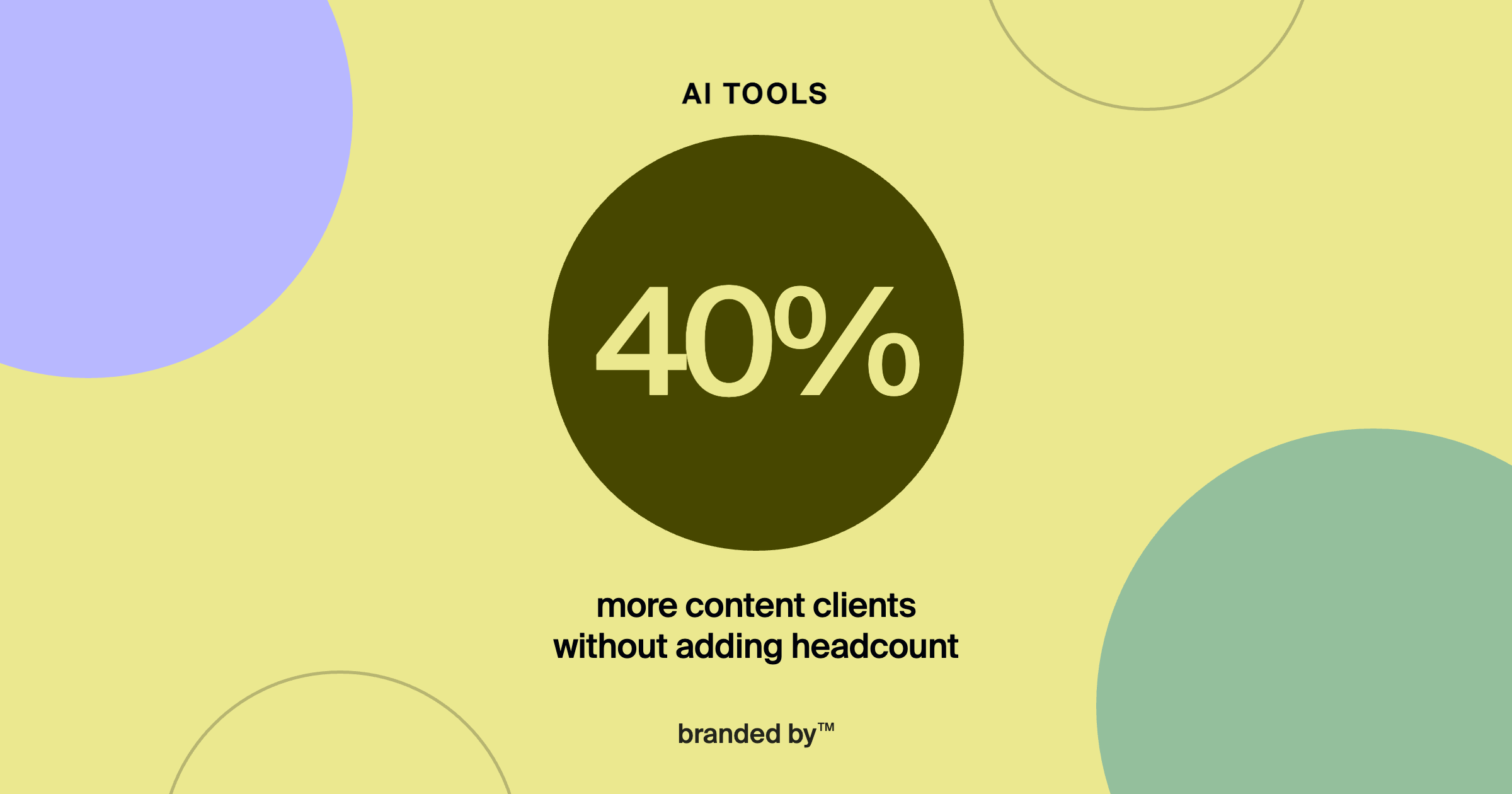
One digital marketing agency working with e-commerce brands reported that after integrating Claude into their content workflow, they were able to take on 40% more content clients without adding headcount. The writers on their team didn't feel replaced — they felt relieved. The tedious parts of the job (staring at a blank page, structuring repetitive formats, creating first drafts of product descriptions) were handled by Claude, freeing them to focus on editing, storytelling, and strategy.
Claude is also particularly strong at adapting tone and voice. Agencies that manage multiple brand clients have trained it with brand guidelines and sample copy, allowing it to produce on-brand content for each client with less back-and-forth.
Before any strategy is written or campaign is pitched, research has to happen. Understanding a client's industry, their competitors, their audience's language, and the trends shaping their market — this is foundational work, and it's time-consuming.
Agencies have started using Claude to dramatically accelerate this phase. A strategist can provide raw input — a client brief, a set of URLs, notes from a discovery call — and ask Claude to synthesize it into a structured overview. Industry dynamics, competitor positioning, audience pain points, content gaps: Claude can organize and articulate these into something usable in a fraction of the time it would take a junior strategist to build from scratch.
A branding agency that specializes in healthcare clients described using Claude to prep for new business pitches. Instead of spending a full day on research before presenting to a prospective client, they now spend two to three hours with Claude handling the synthesis and structuring. The result is that they can pitch faster, and their proposals feel more informed because they have more time to refine the strategic thinking on top of the research.
It's worth noting that Claude works best when given good inputs. The quality of the research output reflects the quality of the brief you give it. Agencies that build structured research prompts as reusable templates get the most consistent results.
Client reporting is one of those necessary tasks that eats a disproportionate amount of agency time. Pulling data, writing commentary, making numbers understandable to non-marketers, formatting everything to look polished — it can take hours per client, per month.
Several agencies have started using Claude to handle the narrative layer of their reports. They export campaign data — ad performance, SEO rankings, email metrics, social analytics — and paste the numbers into Claude along with context about the client's goals. Claude then drafts the written commentary: what the numbers mean, what worked, what didn't, and what the recommended next steps are.
An agency managing paid media campaigns for a portfolio of local service businesses described saving an average of ninety minutes per client report after integrating Claude into the process. Over a month with thirty active clients, that added up to nearly two full workdays returned to the team. Those hours went back into strategy, client communication, and new business.
The key insight here is that Claude isn't replacing the data analyst or account manager's judgment — it's handling the writing. The human still interprets the data, validates Claude's language, and makes the final call on the narrative. But the blank page is gone, and the first draft arrives in minutes.
Writing proposals is high-stakes work. A poorly written proposal loses business. A great one can define the tone of an entire client relationship. But proposals are also structurally repetitive — most of them follow similar formats, cover similar ground, and require adapting existing case studies and service descriptions to a new context.
This is a natural fit for Claude. Agencies provide their service offerings, relevant case studies, the client's goals from the brief, and any specific requirements for the RFP. Claude drafts a structured proposal — executive summary, approach, deliverables, team overview, timeline, investment — that the account team then tailors and polishes.
A mid-sized full-service agency described cutting their proposal turnaround time from three days to one day on average. They now respond to more RFPs than before, and their win rate has held steady. The time savings allowed their business development team to be more responsive without sacrificing quality.
Claude is also useful for the softer parts of proposals: translating internal agency language into client-facing clarity, making technical deliverables sound accessible, and framing pricing in terms of value rather than cost.
Social media content is relentless. Agencies managing social for multiple clients face an endless content calendar: captions, hashtags, engagement copy, story scripts, carousel text, LinkedIn articles. The volume is high, the turnaround is fast, and every piece needs to feel on-brand and human.
Claude has become a useful production partner for social teams. Given a content brief, a brand voice guide, and the platform parameters, Claude can generate a month's worth of post drafts in a session. Social managers then review, edit, and schedule — spending their time on refinement and strategy rather than generation.
Agencies working with B2B clients have found Claude particularly effective for LinkedIn content, where the writing style is more analytical and the topics require a degree of fluency in the client's industry. Claude can hold a consistent voice across a long content calendar in a way that feels less mechanical than earlier AI tools.
One social agency managing accounts across multiple industries reported that Claude allowed their team to take on an additional four to five client accounts without increasing content staff. The quality bar stayed high because every piece still went through a human review — Claude just eliminated the generation bottleneck.
Agencies accumulate an enormous amount of institutional knowledge: brand guidelines, style guides, process documents, account histories, campaign learnings. This knowledge often lives in someone's head or in a shared drive that nobody can navigate. When a new team member joins, getting them up to speed is slow and inconsistent.
Agencies have started using Claude to make this knowledge more accessible. They feed Claude relevant documents — SOPs, brand guides, past campaign briefs — and use it as an internal reference tool. A new account manager can ask Claude to summarize a client's history, explain the agency's content process, or translate internal jargon into plain language.
Some agencies are also using Claude to create onboarding materials from scratch. Give it your process documentation and ask it to produce a structured training guide for a new social media coordinator — it will produce a clear, organized document that a human then reviews and refines. What used to take a senior team member two or three days to write now takes an afternoon.
Perhaps the least obvious use case — and the one that surprises agencies the most — is using Claude as a brainstorming partner in the early stages of creative development.
Claude isn't a creative director. But it can generate a wide range of conceptual directions quickly, helping teams break out of their initial ideas and explore territory they might not have considered. A creative team working on a campaign brief can spend thirty minutes asking Claude to generate ten different strategic angles, then use those as a jumping-off point for their own creative thinking.
It's particularly useful when a team is stuck or when a brief is ambiguous. Claude can reframe the problem, suggest analogies from other industries, or generate a range of headline directions that spark a conversation. The best creative teams aren't using Claude to replace their ideation — they're using it to pressure-test and expand it.
The newest request agencies are fielding isn't about using Claude — it's about showing up in it. When a prospect asks Claude or ChatGPT "what agency can help with X" or "who's the best [service] near me," the answer is usually two or three names. Clients want to be one of them.
That work is answer engine optimization (AEO): making a brand easy for AI systems to understand, verify, and cite. It comes down to consistent entity information across the web, pages that answer real questions directly, third-party mentions and reviews that AI trusts, and tracking which prompts actually mention the brand. We break down how AI decides who to recommend in Will AI Recommend Your Brand? and the specific signals in Brand Trust Signals That Make AI Recommend You.
Where the time comes back
| Workflow | Before Claude | With Claude |
|---|---|---|
| First-draft content | Two to three hours to draft | Thirty to forty-five minutes of guided work |
| Pitch research | A full day | Two to three hours |
| Client reports | Hours per client | About ninety minutes saved per report |
| Proposals | Three days | One day |
| Onboarding guides | Two or three days of senior time | An afternoon |
As reported by the agencies described above. A human still reviews every piece.
Across these use cases, a few patterns emerge from agencies that are getting the most value from Claude.
First, the quality of what you get out is directly tied to the quality of what you put in. Agencies that invest time in building detailed, structured prompts — and that document those prompts as reusable templates — consistently get better results than those who use it ad hoc.
Second, Claude works best when a human is in the loop at the end. The agencies seeing the most success aren't trying to remove human judgment from the process — they're removing the grunt work so human judgment can be applied where it matters most.
Third, integration takes time. Agencies that pilot Claude on a single workflow, learn from that experience, and then expand see better results than those who try to implement it everywhere at once.
Claude isn't magic, and it isn't a replacement for skilled, experienced agency professionals. But for agencies that invest the time to learn how to use it well, it's a genuine force multiplier — one that helps teams move faster, take on more work, and deliver better results for clients without burning out the people doing the work.
The agencies that figure this out now will have a meaningful operational advantage over those that wait. The question isn't whether AI belongs in your agency workflow. It's which workflows you're going to improve first.
Mostly for first drafts of content, research synthesis, client report commentary, proposals, social content calendars, internal knowledge bases, and brainstorming. People stay responsible for strategy, editing, and final approval.
No. Agencies getting the most value use Claude to remove repetitive work — blank pages, formatting, first-pass synthesis — so strategists and creatives spend more time on the judgment calls clients pay for.
Through answer engine optimization: consistent business information across the web, pages that answer real questions directly, credible third-party mentions and reviews, and tracking the prompts where your brand does and doesn't appear.
Pick one workflow — client reporting or first-draft content are the easiest — build a reusable prompt template with your brief format and brand guidelines, run it for a month, and expand once the process is reliable.