September 29, 2026
How a Local Business Becomes the Name Everyone Knows
Ask anyone in your town who to call for a new roof and most will say the same name. Here's how a local business becomes that name, and why there's no shortcut.
Key takeaways
Not every manufacturer does. Run through these before you spend a dollar.
Two or more of these, and it's worth a conversation.
Pacific Sands could do serious volume. Liquid batching up to 1,000 gallons. Powder output up to 40,000 pounds per shift. ISO 9001:2015 certified. EPA-registered facility. They were already manufacturing for brands ranging from a startup's first SKU to an enterprise doing $40+ billion in revenue.
Their facility is small. Prospects would tour it and quietly downgrade what they thought was possible.
Nothing about the operation needed fixing. The belief gap did.
Takeaway for your business: before you brief a single designer, write one sentence describing what's actually capping growth. If you can't, you're about to buy a logo instead of a result.
"Pacific Sands" reads like a beach resort. It gave a buyer nothing.
We renamed them NovoBlend. Novo — new. Blend — the literal thing happening on that floor every shift.
A manufacturing name doesn't have to be clever. It has to be sayable on a call, spellable in an email, and pointed at what you make.
When renaming is worth it:
When it isn't: if you have real search equity, existing contracts tied to the name, or brand recognition you'd be throwing away. Reposition instead.
For NovoBlend: Performance. Safety. Reliability.
Not aspirational. Not clever. Those are the three things a procurement lead has to feel before they hand you a formula and a PO.
Industrial brand positioning is mostly subtraction. You're choosing what not to say so the few things you do say land.
How to find yours: call five customers and ask what almost stopped them from signing. The objection you hear twice is your positioning.
Marks, color, typography, illustration rules, motion behavior, voice — documented.
This is the stage manufacturers skip, and it's why so many rebrands drift within a year. Your team is going to build spec sheets, trade show booths, labels, and safety documentation for a decade. Without guidelines, fifty people improvise fifty versions of you.
What a manufacturing brand guide needs that others don't:
You can't fly a prospect to your facility on the first click. But you can walk them through the operation.
For NovoBlend we mapped three things:
What they handle — research and product development, liquid and powder manufacturing, then packaging, fulfillment, and logistics.
How it works — six steps: discovery call, formula development, packaging and artwork, production, quality checks, fulfillment and shipping.
Where a buyer fits — nine industry paths. Household cleaning, retail and private label, spa and pool care, industrial and institutional, janitorial, vehicle care, specialty cleaning, personal care, pet care.
That last one matters more than most manufacturers realize. A janitorial supply buyer and a pet care startup are not the same person and shouldn't land on the same page. Industry-specific pages also happen to be how manufacturers win long-tail search.
Photography would have shown a small building. So we didn't lead with photography.
Illustration and animation carried it instead — the process moving from lab to blend to fill to pallet. That shows scale of operation rather than square footage, and it solves the exact problem that was costing them deals.
What we put above the fold: the capability numbers. Batch sizes. Output per shift. Certifications. The $40+ billion client that had been buried.
Manufacturing website essentials, in priority order:
Site launched. Then paid advertising went behind it, targeted at high-ticket prospects.
The order is the point. Driving traffic to a site that undersells you just buys you a bigger audience for the wrong impression. Get the positioning and the site right, then spend.
Rough sequence to plan around: strategy and naming → positioning → guidelines → UX → build → launch → advertising → content. Four to six months for a manufacturer doing it properly.
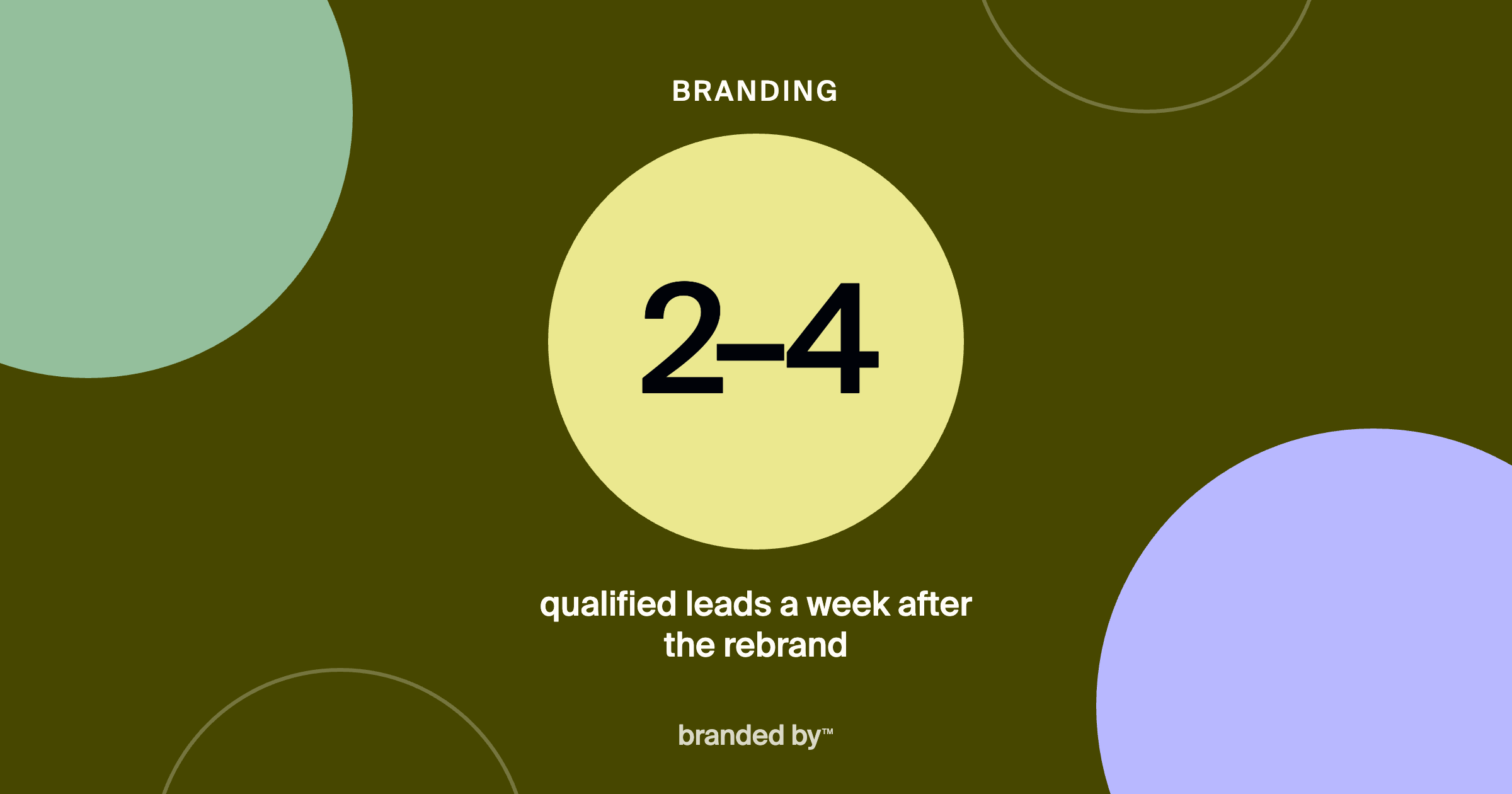
NovoBlend is now averaging 2–4 qualified, high-ticket leads per week. Qualified — not traffic, not form fills.
They're tracking toward the $4M to $10M goal. Not there yet. It's a twelve-month run and it's in progress. But the pipeline that gets them there is finally moving.
Same facility. Same equipment. Same team. Same capability they had the entire time.
That's usually how this goes. The rebrand didn't create the capability — it just stopped hiding it.
How long does a manufacturing rebrand take?Four to six months from strategy through launch, assuming naming is involved. Repositioning without a name change moves faster.
Do we have to change our name?No. Naming is one stage of eight, and plenty of manufacturers only need positioning, guidelines, and a new site.
Will we lose our existing customers?Not if it's sequenced right. Tell your customers and partners before the market. NovoBlend kept its Pacific Sands, Inc. parent identity intact through the transition.
How do we measure whether it worked?Qualified lead volume and lead quality — not traffic or impressions. Set the baseline before you start so you have something to compare against.
Should we rebrand before or after investing in advertising?Before. Ads amplify whatever impression your brand is already making.
Before and after → Watch the video
Full case study → brandedby.co/portfolio/novoblend
Live site → novoblend.com
If your business is getting read smaller than it actually is — let's talk.


