August 12, 2026
The Profitability Equation: How to Know What to Spend to Acquire a Customer
A practical framework for deciding what to spend on customer acquisition, using LTV, CAC, and the real math behind marketing budgets.
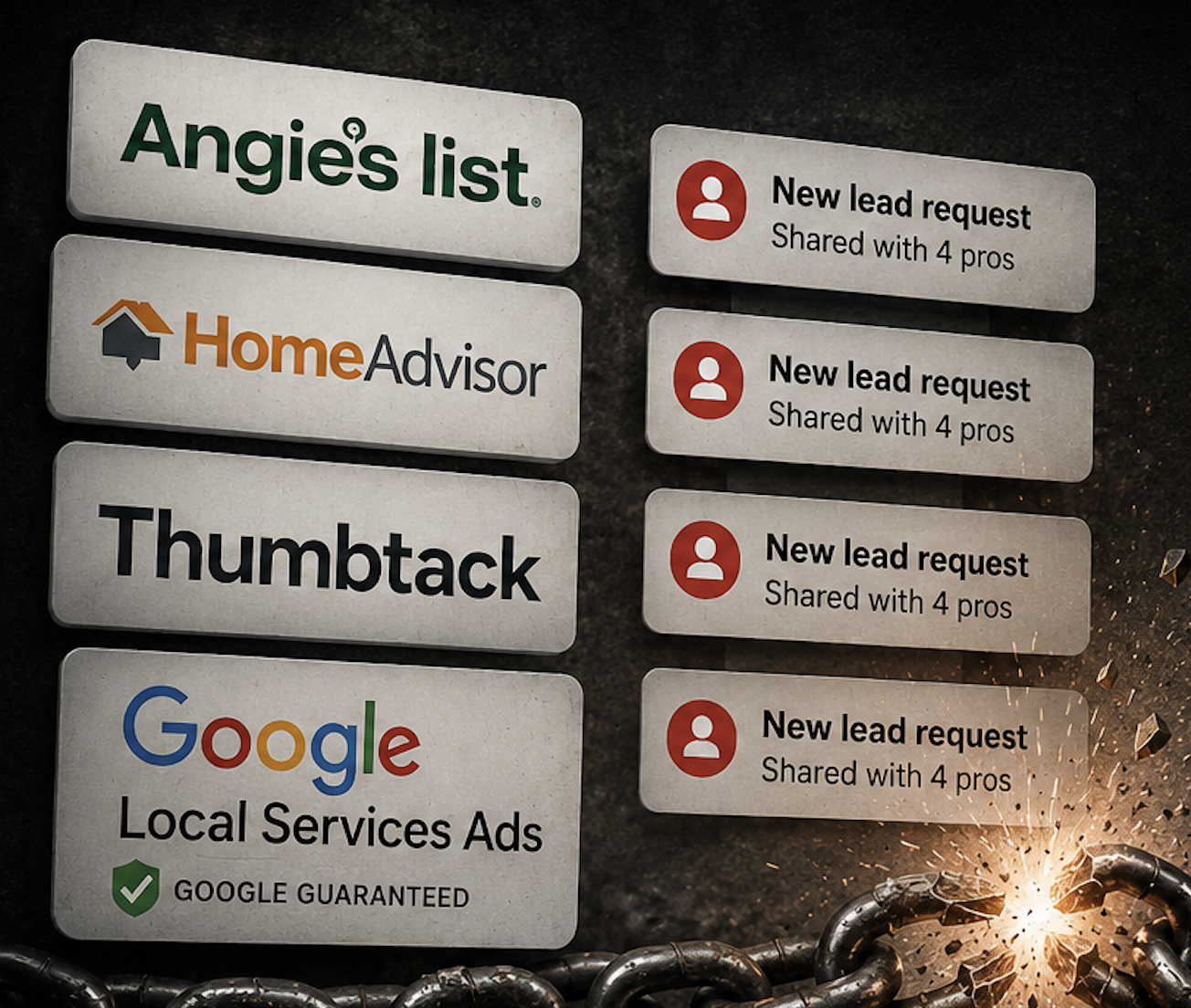
If you run a home service business and you're spending real money every month on Angie's List, HomeAdvisor, Thumbtack, or Google Local Service Ads, here's the uncomfortable truth: you're not building a customer base. You're renting access to strangers who are shopping several of your competitors at the same time.
That's not a knock on your marketing. It's how those platforms are built to work.
When a homeowner fills out a request on Angie's List or Thumbtack, that lead typically gets sold to multiple companies at once, often three to five competitors, all working the same request at the same time. The result is a race, not a sales process. Whoever responds fastest and quotes lowest wins the job, regardless of who actually does the best work. That structure trains your best prospects to shop on price before they've seen anything else about your business.
Google Local Service Ads have a different problem. There's no room to differentiate. You're paying per lead, full stop, and a meaningful share of those leads are junk: wrong service area, wrong job type, tire-kickers who never intended to hire anyone. Someone on your team still has to read every one of them, figure out which are real, and follow up, time that isn't spent selling to a homeowner who actually wants your company specifically.
Here's the part that gets missed. A lead that comes through one of these platforms might skim a handful of star ratings before they call. That's it. They never see your website, your story, what makes your crew different, or why you charge what you charge. They're comparing phone numbers, not companies. If price is the only thing they can compare, price is what they'll decide on, and you'll lose that fight to whoever's willing to work for less.
Early in my career, I worked with a home service provider operating in more than thirty cities, doing millions of dollars a month in revenue. They were spending six figures a month on Google Ads and another five figures a month on leads from Angie's List. When we finally sat down and audited where that money was actually going, three things stood out.
First, they were being billed multiple times for the exact same lead. The same homeowner request, sold and charged more than once.
Second, a real chunk of the leads they were paying for were fake. Not low-quality, fake. Submitted by nobody who ever intended to hire a contractor.
Third, and this is the one that changed how I think about these platforms permanently: some of the "companies" showing up in the results, small outfits with names like a father-and-son plumbing business, weren't real service providers at all. They were fronts. Storefronts built specifically to capture homeowner data and resell it as leads, and buried in their own fine print, some of them were also buying lead data from third-party brokers and reselling it again. The homeowner thought they were getting quotes from local companies. They were getting funneled into a resale pipeline.
That's the model you're paying into every time you buy a lead instead of building your own.
The audit turned up more than duplicate billing and fake leads. Once we looked closely at the data, three more patterns showed up that changed how we thought about these platforms for good.
Response time decided almost everything. If a lead from Angie's List didn't get a call back within the first five minutes, the odds of booking that job dropped sharply, and kept dropping the longer it sat. That's not a sales training problem. That's the platform training homeowners to expect near-instant contact, because they know several companies are chasing the same lead at the same time.
We were also paying for the same customer twice. A homeowner would show up as an Angie's List or HomeAdvisor lead, then show up again days later as a paid Google Ads lead, the same person shopping the same job through two different channels we were both paying for.
And the job economics told two different stories depending on the channel. Angie's List leads tended to close smaller jobs at a higher cost per sold job. Google Ads leads tended to close larger jobs at a lower cost per sold job. Same market, same industry, two channels producing worse customers at a higher price on one side and better customers at a lower price on the other.
The fix isn't complicated, but it does take real investment: build owned brand assets and a real digital presence, so your company controls its own lead flow instead of renting it from a platform that's also selling your competitor the exact same homeowner.
That means a website that actually makes your case instead of a form on someone else's site, a brand a homeowner recognizes and trusts before they ever call, and advertising you run and own the data from, instead of paying per click to a platform designed to keep you dependent on it. We've seen this play out with our own home service clients, like Hot Springs Pools and Spas, who made this exact shift from a generic, unclear presence to a brand homeowners actually recognize.
We built our pricing around exactly this transition: an ascending path off lead-platform dependency, not a one-size package.
Foundation is the entry point, best for businesses focused on lead generation. It includes a one-page, conversion-ready website, Google Ads account setup and management, local visibility work, and a dedicated account manager, on a three-month minimum commitment. This is where a home service company stops paying per lead and starts owning a real acquisition channel.
Growth includes everything in Foundation and adds positioning: a three-page conversion-ready website, your actual brand mark, color, and typography, and Meta Ads account setup and management. This is the stage where homeowners start recognizing your business before they ever request a quote, instead of choosing you cold off a lead form.
Partnership includes everything in Growth, plus a five-page conversion-ready website, full graphic and social media guidelines, and multi-channel advertising. This is the tier built for companies ready to stop competing on price altogether and dominate their market on brand strength.
All three carry the same three-month minimum commitment. Building something that replaces a rented lead pipeline takes a real runway, not a one-off campaign.
This applies most directly to home service companies doing somewhere between one and ten million dollars a year in revenue, past the point where a single lead platform can realistically fund growth, but before they have the internal marketing team to build this in-house. If you're spending five or six figures a month on leads you don't own, from homeowners who never actually met your brand, that spend is better redirected into something that compounds instead of resetting every month.
It depends on where you're starting. For businesses under $3 million that have never run their own ads, we recommend starting around $1,000 a month for the first one to three months just to gather honest data. Businesses over $3 million typically need $3,000 to $50,000 or more a month, based on a full audit of their market and competition.
We've worked with businesses from $300,000 to $50 million and up in annual revenue, including home service companies scaling past the point where lead platforms alone can support growth.
Yes, three months across all retainer engagements, including all three tiers. Replacing a rented lead pipeline with an owned one takes a real runway.
Angie's List, HomeAdvisor, Thumbtack, and Google Local Service Ads aren't going away, and they're not without a use case for a business just getting started. But if you've outgrown paying per lead for homeowners who are also getting several other calls that same hour, the real move is building the brand and digital presence that lets people choose you on purpose. That's what the shift from Foundation to Growth to Partnership is built to do.
See the full breakdown of all three tiers on our pricing page.